

AI Digital Employees in Accounting: The next stage of automation
Future accounting teams could include local accountants, offshore accounting professionals, automation and AI Digital Employees, explains Ryan Morris.
 |
Ryan Morris is Head of Sales North America at Talent Formula. |
FOR most accountants, artificial intelligence still operates as a tool that responds to a request.
An accountant provides a prompt, uploads a document or asks a question. AI produces an answer, summary or draft, and the accountant decides what happens next.
This model has already created meaningful productivity gains. But it may represent only the first stage of AI adoption in accounting.
The next stage could involve AI taking responsibility for defined elements of accounting work rather than simply assisting an individual with isolated tasks.
This is where the concept of the Digital Employee becomes more interesting.
A Digital Employee is not a human employee working offshore or an outsourced accounting professional. It is an AI worker configured around a defined accounting role or workflow, with set responsibilities, permissions and points for human review.
From AI assistant to Digital Employee
The distinction is important.
An AI assistant waits for instructions.
A Digital Employee operates within a defined process.
For example, rather than asking AI to review one document, a Digital Employee could be configured to review incoming documents as part of a broader workflow, extract relevant information, compare it against existing data, identify exceptions and route those exceptions to an accountant.
The accountant remains responsible for review and professional judgement, but no longer needs to manually drive every stage of the process.
This changes the role of AI from a tool used occasionally by an individual accountant into something that can participate in the way accounting work moves through a firm.
What makes a Digital Employee different?
The term can easily become another piece of technology jargon, so a useful definition matters.
A Digital Employee should have a defined role, defined permissions and a defined workflow.
It should know what information it is allowed to access, which actions it can perform, when an exception should be raised and when a human needs to become involved.
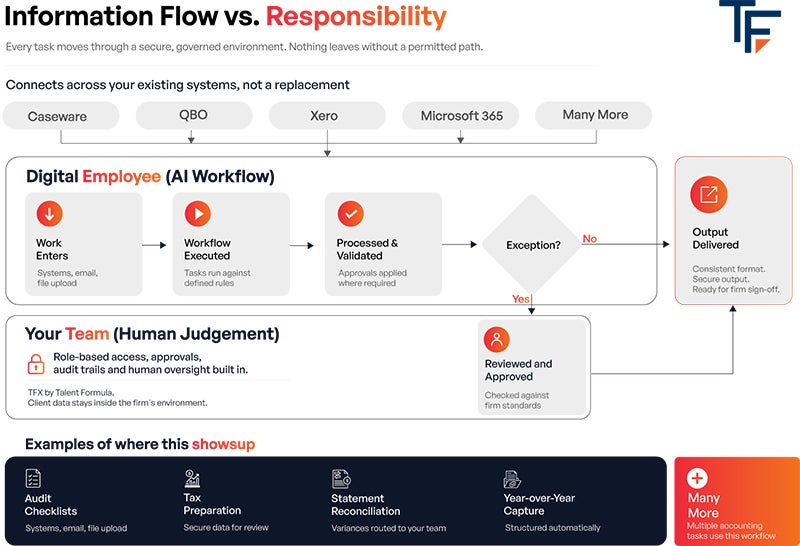 |
CLICK ON TO ENLARGE. Find out more about Talent Formula's secure AI workspace built for accounting firms.
|
For accounting firms, that creates potential applications across areas such as bookkeeping, reconciliations, compliance, audit support, financial reporting and internal practice operations.
The value is not that AI can suddenly “do accounting.”
The value is that specific components of accounting work can be structured in a way that allows AI to complete them consistently and at scale.
Platforms are beginning to emerge around this model. TFX by Talent Formula, for example, brings Digital Employees together with secure AI and structured accounting workflows, providing one example of how firms can move from isolated AI use towards AI operating within a controlled delivery environment.
What could this mean for accountants?
The obvious question is whether this changes the role of the accountant.
It almost certainly does, but perhaps not in the way the automation debate is often framed.
Professional judgement, interpretation, client communication, commercial understanding and the ability to challenge unusual or incomplete information remain fundamentally different from repetitive processing.
Yet accountants still spend significant amounts of time on work that is structured, repeatable and administratively intensive.
Digital Employees create an opportunity to redistribute some of that work.
The accountant’s role could increasingly shift towards reviewing exceptions, resolving complexity and applying judgement rather than manually completing every step in a process.
Exception-based working could become more common
This may be one of the more significant changes AI introduces into accounting delivery.
Many accounting processes currently require people to review every transaction, document or data point, even when most of the activity is routine.
AI creates the possibility of reversing that model.
Technology processes the standard activity and accountants focus on what falls outside the expected pattern.
For firms facing capacity constraints, this matters.
Efficiency gains do not necessarily have to come from making accountants work faster.
They may come from reducing the volume of routine work that reaches an accountant in the first place.
More autonomy requires stronger controls
As AI takes on more responsibility within a workflow, the controls around it become more important.
A Digital Employee cannot simply be given unrestricted access to systems and allowed to operate independently.
Firms need to consider permissions, audit trails, data security, exception thresholds and approval points. Human oversight also needs to be deliberately designed into the process.
The objective should not be automation for its own sake.
It should be about allocating each part of the workflow to the resource best suited to perform it, whether that is software, AI or a qualified accountant.
A different way to think about capacity
Accounting firms have traditionally responded to increasing workloads by increasing headcount.
Offshoring and shared service models have already challenged that assumption by giving firms access to broader talent pools and different ways of structuring accounting teams.
Digital Employees introduce another dimension.
Future accounting teams could include local accountants, offshore accounting professionals, automation and AI Digital Employees, with each handling different components of the delivery process.
That does not necessarily mean firms need fewer accountants.
It means firms may be able to become more deliberate about where accountants spend their time and where technology can take on a greater share of routine delivery.
The shift from AI assistant to digital co-worker is still developing.
But it changes the question from:
“How can AI help an accountant do this task?”
to:
“Which parts of this workflow actually need an accountant involved?”
That is a question accounting firms should start asking now.
Ryan Morris is Head of Sales North America at Talent Formula. Ryan works with accounting firms and finance leaders across Canada on offshore delivery, workflow automation, Digital Employees and the practical use of AI. Through his work with Talent Formula and TFX, he has a first-hand view of how firms are responding to talent shortages, rising workloads and the need to modernise without compromising quality or security.
This sponsored content was produced by Talent Formula; Canadian Accountant's editorial department was not involved in its creation. Images courtesy Talent Formula.






(0) Comments