

The accountant in the loop: why AI adoption is creating the biggest advisory opportunity
Key findings from the Intuit QuickBooks 2026 AI Impact Report, which surveyed 34,000 SMB owners, and three questions to bring to your next client meeting
This article draws on findings from the Intuit QuickBooks 2026 AI Impact Report, which surveyed more than 34,000 small and mid-sized business owners across the US, Canada, the UK, and Australia, combined with anonymized data from more than 5.3 million QuickBooks businesses. The methodology was developed by an international team of economists led by Ufuk Akcigit of the University of Chicago, in collaboration with Intuit.
Key findings
- 69% of Canadian SMBs now use AI regularly, up from 52% in 2024
- Nearly 8 in 10 (78%) of businesses that paid for AI tools last year are still paying for them
- 73% of Canadian SMBs say AI has improved their productivity, up from 49% in 2024
- 37% of Canadian SMBs say AI has already increased their revenue
- The three biggest barriers to deeper adoption map directly to accountants' existing expertise
Here is something worth sitting with: according to the Intuit QuickBooks 2026 AI Impact Report, nearly 7 in 10 Canadian small businesses now use AI regularly, up from 52% in 2024. Many of them started in the last eighteen months. A significant share of that adoption is already touching financial data, making having a professional in the loop more important than ever.
Intuit serves 10 million businesses globally — and one million accounting professionals among them — which means it operates the infrastructure where the SMB-accountant relationship plays out at scale.
The question for Canadian accounting professionals is not whether to engage with this shift. It is how quickly, and on what terms.
Where are Canadian SMBs using AI in 2026?
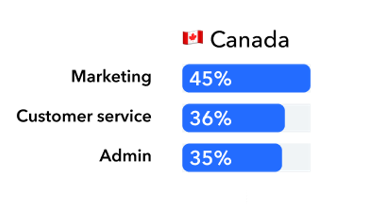 |
Source: Intuit QuickBooks 2026 AI Impact Report, Figure 20. |
Businesses report using AI most in marketing, customer service, and admin. That is the busywork layer, where speed matters and outputs are easy to review. But those front office tasks feed the back office faster than most clients realize: follow-ups affect AR, customer communication affects retention, and admin affects how quickly work gets done and billed.
And for a meaningful share of businesses, AI is already showing up closer to the books. Beyond the top 3 AI tasks, nearly 3 in 10 Canadian businesses report using AI to support bookkeeping. This signals AI-assisted inputs are entering the workflow, and that makes professional review, documentation, and judgment more valuable, not less.
Not all AI use creates the same level of risk or opportunity. A client occasionally using a free tool to draft marketing copy faces a different set of questions than one using AI in workflows that touch customer billing, cash flow, or financial records.
Why are Canadian businesses hesitant to go further with AI?
Three barriers are holding Canadian SMBs back from deeper AI adoption:
- Privacy and security concerns — cited by 36% of Canadian SMBs
- Lack of knowledge — cited by 30%
- Fear of bias/errors — cited by 26%
These concerns come down to trust and accountability. That’s the accountant’s value proposition.
"What we're seeing in the data is that Canadian SMBs are increasingly confident in AI's ability to improve productivity, but they still want human oversight when decisions carry financial or operational risk," said Simon Worsfold, Head of Data Communications at Intuit. "That creates an important role for accounting professionals as businesses look to adopt AI more confidently and strategically."
An AI tool can categorize thousands of transactions in seconds. It cannot be held professionally accountable for a single one of them. It cannot tell a client whether their AI-assisted categorization will hold up in a CRA audit. That determination requires a human with credentials, context, and liability.
|
|
What happens when AI adoption produces results?
"You could save a lot of time and energy implementing AI in certain areas of your business while still remaining hands-on in the areas that matter most to you." - Olivia Petrou-Stanchev, Founder, Olive & Fig.
Among your Canadian business clients that paid for an AI tool in 2024, 78% are still paying for it in 2025 — a strong signal that the tools are delivering perceived value. On average since April 2025, 37% of Canadian SMBs say AI has increased their revenue.
Clients getting results do not stop needing professional advice. They start asking harder questions: Which outputs can I actually trust? Where am I exposed? What does this mean for my year-end filing? These are not questions a tool can answer. They require someone who knows the client's business, understands the CRA's expectations, and can be held to account if the answer is wrong.
Three questions to bring to your next client meeting:
1. What AI tools is your business currently using?
Most clients haven't been asked. The answer tells you where they are exposed.
2. Are any of those tools touching your financial data?
Many clients genuinely don't know. This is the line that matters for CRA compliance and liability.
3. Have the outputs been reviewed by a qualified professional?
AI produces confident-sounding results that can be structurally wrong. A validation process is a defensible, billable scope of work.
For the clients already using AI and seeing results, that conversation is already overdue. They are going to start asking harder questions. Those are advisory conversations waiting to happen.
The bottom line: what does AI adoption mean for Canadian accountants?
The role of the human expert in small business finance is not shrinking — it is moving up the stack. The data across one million accounting professionals on the Intuit platform points to a consistent principle: AI where it counts, human when it matters.
With more than two-thirds of your clients already generating AI-assisted financial outputs, the question is not whether professional oversight of those outputs is necessary. The question is whether that oversight is happening — and whether you are providing it.
This sponsored content was produced by Intuit; Canadian Accountant's editorial department was not involved in its creation.





(0) Comments