

Notice of Assessment was never mailed? Federal Court of Appeal clarifies taxpayer must first prove non-delivery
The FCA Siam decision reinforces that taxpayers bear the burden of proving that a Notice of Assessment was not sent, and credibility plays a central role
Overview: Can You Challenge a CRA Tax Reassessment If You Never Got the Original Notice?
 |
David J Rotfleisch, CPA, JD is the founding tax lawyer of Taxpage.com and Rotfleisch & Samulovitch P.C., a Toronto-based boutique tax law corporate law firm. |
In Siam v. Canada, 2026 FCA 91, the Federal Court of Appeal considered whether a taxpayer had proven that an original Notice of Assessment was not sent by the Canada Revenue Agency (CRA), thereby affecting the normal tax reassessment period and the taxpayer’s right to object to a later tax reassessment. The decision clarifies the taxpayer’s burden of proof, the importance of credibility, the limited scope of appellate review of factual findings, and the principle that the doctrine of legitimate expectations cannot create substantive rights contrary to the Income Tax Act.
Facts of the Case in Siam v. Canada
Mohamed Siam appealed a Tax Court decision to the Federal Court that had quashed his appeal concerning a tax reassessment of his 2016 taxation year. The CRA issued the tax reassessment on August 18, 2023. The Tax Court concluded that the tax reassessment had been issued under subsection 152(4.2) of the Income Tax Act because it occurred after the normal tax reassessment period had expired and followed the taxpayer’s request for a refund or reduction of tax. Since subsection 165(1.2) prohibits objections to reassessments made under subsection 152(4.2), the Tax Court held that Mr. Siam’s notice of objection was invalid.
The dispute centred on whether the normal tax reassessment period had actually expired. Mr. Siam argued that he did not receive the original Notice of Assessment issued in 2018 until a later date. According to him, if the notice had not been sent in 2018, the normal tax reassessment period had not yet begun, meaning the 2023 tax reassessment would not fall within subsection 152(4.2).
The Tax Court applied the framework established in Mpamugo v. The Queen and concluded that Mr. Siam failed to prove that the 2018 Notice of Assessment had not been mailed. The Court found that his evidence was not credible, both regarding his assertion that he never received the notice and his suggestion that it had been mailed to the wrong address.
On appeal, Mr. Siam argued that the Tax Court improperly assessed his credibility, that the CRA’s affidavit referred only to the Notice of Assessment being “issued” rather than “mailed,” and that the CRA had led him to believe he possessed a right to object because both the tax reassessment and the responsible CRA officer informed him that an objection could be filed.
The Federal Court of Appeal rejected each argument. It held that the Tax Court committed no palpable and overriding error in assessing the evidence, properly applied the Mpamugo framework, and correctly concluded that the normal tax reassessment period had expired before the 2023 tax reassessment. The Court also held that the doctrine of legitimate expectations cannot create a substantive right that Parliament has expressly denied.
The Importance of Credibility in Siam v. Canada
One of the most significant aspects of Siam is the emphasis placed on credibility.
The Federal Court of Appeal confirmed that the Tax Court may assess a taxpayer’s credibility at the first stage of the Mpamugo framework after hearing all of the evidence. If the Tax Court concludes that the taxpayer has not credibly established that the notice was never mailed, the Court need not proceed further with the remaining steps of the analysis.
A taxpayer’s testimony is evidence, but the Court must believe it before it can meet the burden of proof.
This serves as an important reminder that documentary records, correspondence, address history, and other objective evidence often become critical in disputes involving notices issued by the CRA.
Deference to the Tax Court on Factual Findings
The Federal Court of Appeal also emphasized how difficult it is to overturn factual findings on appeal.
An appellate court will intervene only where the lower court made a “palpable and overriding error.” In practical terms, this means an error that is obvious and that affects the outcome of the case. Disagreement with how the trial judge weighed the evidence is generally insufficient.
Mr. Siam argued that the CRA affidavit referred only to the Notice of Assessment being “issued” rather than expressly stating that it had been “mailed.” The Court rejected this argument, finding that the wording did not establish any reviewable error or prevent the Tax Court from concluding that the notice had been sent.
Legitimate Expectations Cannot Override the Income Tax Act
The final issue involved procedural fairness.
The CRA had apparently advised Mr. Siam that he could object to the tax reassessment, and the tax reassessment itself indicated that an objection could be filed. Unfortunately for the taxpayer, the Court held that incorrect information from the CRA cannot create a right that Parliament has expressly removed.
Good administration by the CRA is important, but administrative mistakes cannot rewrite the Income Tax Act. Unfortunately, information provided by the CRA cannot be relied upon.
The Court acknowledged that the CRA should review its practices but confirmed that the doctrine of legitimate expectations affects procedural rights only. It cannot create substantive appeal rights prohibited by legislation.
Implications of the Decision of Siam v. Canada for Canadian Taxpayers
The Federal Court of Appeal’s decision in Siam v. Canada serves as an important reminder that procedural requirements under the Income Tax Act can be just as important as the underlying tax dispute. The case demonstrates that a taxpayer who claims that a Notice of Assessment was not sent bears the burden of proving that claim with credible evidence. Simply asserting that a notice was received late or not received at all may not be enough if there is no objective evidence to support the allegation.
Canadian taxpayers should therefore maintain good records relating to CRA correspondence. Keep copies of Notices of Assessment, Notices of Reassessment, CRA letters, envelopes showing postmarks where available, email notifications from the CRA, and screenshots or records from the CRA’s online portal. These documents may become important evidence if the timing or delivery of a CRA notice is later disputed.
Taxpayers should also promptly document any change of address. Notify the CRA as soon as an address changes, retain confirmation that the update was made, and keep copies of any correspondence or online confirmations showing the date of the change. If a dispute later arises over whether a Notice of Assessment was mailed to the correct address, these records may help establish the relevant facts.
If a Notice of Assessment or Notice of Reassessment appears to have arrived unusually late, do not simply set it aside. Record the date it was received, retain the envelope if it shows a mailing date or postmark, preserve any electronic notifications relating to the notice, and review the applicable objection or appeal deadlines immediately. Where appropriate, contact the CRA to clarify the mailing history and seek legal advice without delay, as statutory deadlines may continue to apply.
Tax litigation begins with evidence. If the evidence is weak, even a potentially valid legal argument may never get off the ground.
Takeaways from Siam v. Canada
Siam v. Canada reinforces several important principles of Canadian tax litigation. The taxpayer bears the burden of proving that a Notice of Assessment was not sent, credibility plays a central role in meeting that burden, appellate courts rarely interfere with factual findings absent a palpable and overriding error, and incorrect advice from the CRA cannot create statutory appeal rights that do not exist.
David J Rotfleisch, CPA, JD is the founding tax lawyer of Taxpage.com and Rotfleisch & Samulovitch P.C., a Toronto-based boutique tax law corporate law firm and is a Certified Specialist in Taxation Law who has completed the CICA in-depth tax planning course. He appears regularly in print, radio and TV and blogs extensively.
With over 30 years of experience as both a lawyer and chartered professional accountant, he has helped start-up businesses, cryptocurrency traders, resident and non-resident business owners and corporations with their tax planning, with will and estate planning, voluntary disclosures and tax dispute resolution including tax audit representation and tax litigation. Visit www.Taxpage.com and email David at david@taxpage.com.
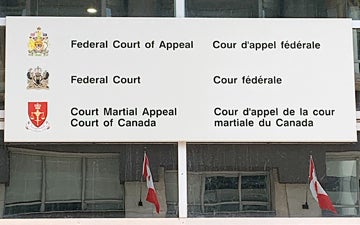
Read the original article in full on Taxpage. Author photo courtesy Rotfleisch & Samulovitch P.C. The content of this article is intended to provide a general guide to the subject matter. Specialist advice should be sought about your specific circumstances. Title image: Entrance sign for three federal courts registry office, 90 Sparks Street, Ottawa Ontario (Wikimedia Commons, Creative Commons CC0 1.0 Universal Public Domain Dedication).







(0) Comments