

CPA Canada survey indicates rapid integration of AI in Canadian accounting profession

Most chartered professional accountants do not see AI as a threat to CPA service demand but rather as a tool for productivity, analysis and problem-solving
 |
|
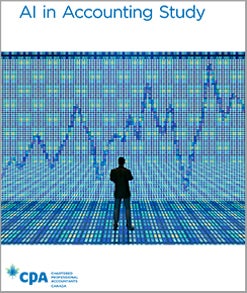
Learn more and download CPA Canada’s AI in Accounting Survey. |
TORONTO, October 18, 2026 – Artificial Intelligence is integrating rapidly into the Canadian accounting profession as chartered professional accountants report significant benefits from AI. Nearly three-quarters of Canadian CPAs (74%) use AI at least weekly, including 40 per cent who use it daily, as CPAs cite tangible benefits such as productivity, analysis and problem-solving, and the ability to focus on higher-value work.
A recent survey from Chartered Professional Accountants of Canada reveals the who, what, when, where and why of AI adoption as well as those pockets of resistance within the profession. A close reading of the survey reveals what type of CPAs are more advanced in AI adoption as well as popular tools, concerns, and outlooks.
AI adoption has accelerated rapidly across organizations, according to the CPA Canada survey. In just three years, frequent or extensive AI use increased from five per cent to 43 per cent, while the share of organizations not using AI fell from 62 per cent to eight per cent. The benefits increase with use. Daily users are nearly twice as likely as infrequent users to report improved productivity and more than twice as likely to report greater focus on strategic work.
“AI has moved from experimentation to everyday use in Canadian workplaces,” states Melissa Robertson, CPA Canada’s AI and technology lead. “Organizations are seeing real benefit, but governance is still catching up. The policies, training and oversight needed to support responsible use aren’t advancing at the same pace as adoption.”
The 5 W’s of AI adoption in accounting
The CPA Canada survey reveals that daily AI use begins to drop significantly among CPAs by age 55 and older, but is otherwise consistent in terms of age and experience. Respondents aged 25 to 54 report daily AI-use rates ranging from 42 to 44 per cent, while respondents who have held a Canadian CPA designation for fewer than 20 years report similarly consistent rates of 41 to 43 per cent.
The survey also reveals that AI adoption is occurring most rapidly at the highest levels of the executive suite. Sixty per cent of chief executive officers or their equivalent reported daily use of AI. That falls to roughly 30 per cent at the level of staff, associates or their equivalent. Perhaps most surprising is that less than 40 per cent of sole practitioners, who might benefit from productivity gains, reported daily use of AI.
The data suggests that the most prolific AI user is a C-suite executive roughly 40 years of age who achieved their designation in the past two decades. That person is most likely to be using AI for research and information gathering, or drafting, editing or summarizing written content, in terms of general productivity. In terms of professional activity, daily use tends to skew more towards data analysis, tax research, compliance or planning.
Other revelations of the survey include where in Canada AI adoption is occurring as well as what tools are most frequently used.
CPAs driving AI decisions, integration within workplaces
“I am continually impressed by the level at which Canadian CPAs are rising to meet the AI moment,” says CPA Canada president and CEO Pamela Steer. “As AI becomes more embedded in business processes and decision-making, the very human expertise only a CPA can provide will become even more critical.”
More than four in 10 CPAs are involved in decisions related to AI adoption, implementation or workforce planning. CPAs are contributing to AI governance, risk management, controls, workforce planning and organizational readiness.
Organizations are more likely to invest in upskilling and reskilling employees (64%) than reduce headcount (22%) in response to AI adoption. More than half of respondents report that their organizations are redesigning roles or workflows (56%) or reassigning employees to higher-value work (52%).
Despite the rapid integration of AI within the profession, some survey respondents expressed their concerns. Accuracy and reliability (68%) and privacy and confidentiality (55%) rank as the profession’s top AI concerns, while concerns about job loss are comparatively low (14%), reinforcing the importance of building trustworthy AI systems.
“This report reinforces my confidence that Canadian CPAs are approaching AI as they have every major transformation before it: with curiosity, professionalism, integrity and a commitment to continuous learning,” says Steer. “The results suggests that the Canadian CPA profession is not simply adapting to the age of AI. It is helping define what responsible AI adoption looks like in practice.
“AI will undoubtedly help shape the future of the profession; I am confident that the profession will help shape the future of AI.”
Learn more and download CPA Canada’s AI in Accounting survey. Colin Ellis is a contributing editor to Canadian Accountant. With files from CPA Canada. Title image: iStock photo ID:1424122482.




(0) Comments