

When the CRA serves a requirement for information on your firm: What an accountant must do in the first thirty days
KPMG Canada behaved reasonably throughout and was subject to a compliance order anyway, writes Canadian tax lawyer and accountant David J Rotfleisch
Overview: The Requirement Landed on Your Desk, Not Your Client’s
Most commentary on Canada (National Revenue) v KPMG Canada LLP, 2026 FC 793, is addressed to the taxpayer whose records are being sought. This article is addressed to the accountant who received the requirement for information.
That is a different problem. The taxpayer’s question is whether the CRA can reach the documents. The accountant’s question is procedural and immediate: the firm holds documents belonging to a client’s engagement, the client asserts privilege over them, the firm itself has no privilege to assert, and the firm is the party that will be named as respondent in a compliance application if nothing adequate is produced. KPMG conducted itself carefully throughout, and a compliance order was issued against it anyway. Understanding why is the practical lesson for any accounting firm that receives a requirement under subsection 231.2(1) of the Income Tax Act.
The short version is that the order did not turn on whether accountants hold privilege. It turned on the quality of the privilege log and on nobody appearing to defend it within the time the court allowed. Accounting firms tend to assume that asserting privilege on a client’s behalf is enough to pause the process. It is not. The firm can hold the line only for as long as someone is prepared to prove the claim, and the firm itself is rarely the one who can.
Background: What the CRA Asked For and What KPMG Did
In March 2022 the CRA commenced tax audits of a group of holding companies and individuals for their 2019 and 2020 taxation years, to verify whether they had properly reported their worldwide income. On April 25, 2024 the CRA issued a requirement for information to KPMG Canada LLP under subsection 231.2(1), seeking information and documents relating to the valuation, tax planning and professional services KPMG had provided to those taxpayers, or to anyone on their behalf, between January 1, 2016 and December 31, 2020.
KPMG was given thirty days. It sought extensions from the CRA and the Department of Justice, and did not produce by the deadlines. Its position was that a third party had asserted privilege over all responsive material. On February 14, 2025 it provided a privilege log to the Department of Justice listing 924 documents.
What KPMG did next matters, because it was the correct conduct and it still was not enough. KPMG took no position on whether the documents were in fact privileged. It maintained that the privileges belonged to its clients and could not be unilaterally waived by the firm. It offered to provide the documents to the court in a sealed envelope or by any other means that preserved confidentiality. It undertook to abide by whatever the court determined. Five of the taxpayers later released ninety documents from the log without asserting privilege, and the CRA stopped seeking those.
The Federal Court nonetheless ordered production of the balance.
Key Issues and Findings: Why the Order Issued Despite KPMG’s Conduct
Two findings drove the result, and neither is about the status of accountants.
The first is evidentiary. The party asserting privilege bears the burden of proving that disclosure of unredacted documents would reveal privileged legal advice, as the Federal Court of Appeal held in BMO Nesbitt Burns Inc v Canada (National Revenue), 2023 FCA 43. The court found that the privilege log did not contain sufficient information or particulars to support the claims made in it. A log of 924 documents, of unknown length and complexity, asserting privilege at large, does not discharge a burden that operates document by document.
The second is procedural. The court had issued an interim order on May 7, 2026 allowing any person or entity asserting privilege over material in the log to apply to be added as a respondent and make submissions. That order provided that if nobody came forward, the court could decide the application without further appearance. More than thirty days passed. Nobody moved. The record before the court on June 12 was therefore identical to the record on May 7, and the court ordered production, giving KPMG thirty days to comply.
The practical reading for an accounting firm is uncomfortable. The firm did everything open to it. The claims failed because the people who owned them did not substantiate them and did not turn up. A privilege log is evidence, not a cover letter. It either supports the claim document by document or it hands the court a reason to order production, and the firm that compiled it is the one holding the file when that happens.
Practical Implications: What This Means for an Accounting Practice
The firm has no privilege of its own to assert. Canada recognizes no accountant-client privilege, and the firm’s commentary on when an accountant’s work is privileged in Canada sets out the narrow agency exception. Where an accounting firm holds material over which a client claims privilege, the firm is a custodian of someone else’s claim. It can decline to produce while the claim is live, but it cannot prove the claim, because the firm is not the party whose legal advice is at issue.
The client must be put on notice immediately and in writing. The single most consequential fact in this case is that nobody applied to be added as a respondent within the window the court gave. A client who does not know the window exists cannot use it. The firm’s file should record when the client was told, what the client was told, and what the client decided.
The log is the deliverable, and it should be prepared under a lawyer’s direction. Compiling a defensible privilege log means recording, for each document, enough particulars to show on what basis legal advice would be revealed by disclosure. That is a legal exercise. A log prepared in-house, by the same staff who created the underlying working papers, is both weaker evidence and itself producible.
Scope is negotiable and should be negotiated early. The CRA’s third-party powers under section 231.2 are broad but not without limits, as the Federal Court confirmed in Canada (National Revenue) v Shopify Inc, 2025 FC 968, and more recently in the Zeifmans compliance order. The requirement here reached back to January 1, 2016 for tax audits of 2019 and 2020. Whether that reach was justified is a question that is far cheaper to raise with the CRA or the Department of Justice at the outset than to litigate later, and the firm is the party in a position to raise it.
Challenge once, and challenge at the right moment. This is the point the Federal Court of Appeal settled weeks after the KPMG order. In Canada (National Revenue) v Zeifmans LLP, 2026 FCA 147, released September 2, 2026, the court granted a section 231.7 compliance order against a Toronto accounting firm and held that a third party who loses a judicial review of a requirement generally cannot re-litigate the same validity arguments when the CRA later applies for a compliance order, describing the attempt in that case as an abuse of process.
A firm gets one proper opportunity to contest a requirement, and the forum and timing of that challenge decide the outcome. The same decision confirms that a requirement addressed to a partnership is valid, and that a broadly worded requirement is not void for vagueness merely because it calls for interpretation, so a firm hoping that an imprecise requirement will simply fail should not plan on it.
Partial release narrows the dispute. Five taxpayers released ninety documents and those came off the table. Separating the material over which privilege is genuinely arguable from the material over which it is being asserted reflexively reduces both cost and exposure.
Takeaways: The Lesson Is About Process, Not Status
An accounting firm that receives a requirement for information is not in a position to protect a client’s privilege by refusing to produce. It is in a position to buy the client the time and the procedural opportunity to protect it. Whether that opportunity is used is up to the client and the client’s counsel.
A firm that treats the requirement as a client-communication and file-management problem from day one, rather than a compliance problem to be resolved by correspondence with the CRA, comes out of the process with the client’s claims properly ventilated and its own conduct beyond criticism. A firm that does not ends up where KPMG ended up: having behaved reasonably throughout, and subject to a compliance order anyway.
David J Rotfleisch, CPA, JD is the founding tax lawyer of Taxpage.com and Rotfleisch & Samulovitch P.C., a Toronto-based boutique tax law corporate law firm and is a Certified Specialist in Taxation Law who has completed the CICA in-depth tax planning course. He appears regularly in print, radio and TV and blogs extensively.
With over 30 years of experience as both a lawyer and chartered professional accountant, he has helped start-up businesses, cryptocurrency traders, resident and non-resident business owners and corporations with their tax planning, with will and estate planning, voluntary disclosures and tax dispute resolution including tax audit representation and tax litigation. Visit www.Taxpage.com and email David at david@taxpage.com.
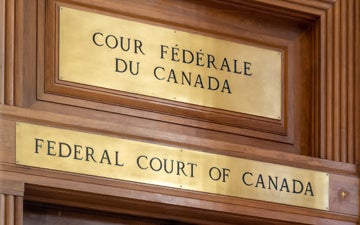
Read the original article in full on TaxLawCanada. Author photo courtesy Rotfleisch & Samulovitch P.C. The content of this article is intended to provide a general guide to the subject matter. Specialist advice should be sought about your specific circumstances. Title image: The bilingual English and French sign of the Federal Court of Canada inside the Supreme Court of Canada building in Ottawa, iStock ID 1277383177.







(0) Comments