

Christian charities see spike in revocations for serious violations in 2025
Sometimes people think their sector is being persecuted or highlighted and that's not really the case, says CCCC spokesperson, who takes no issue with CRA
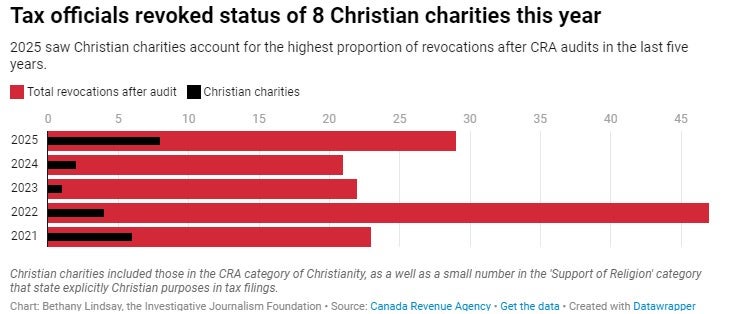
VANCOUVER, Jan. 5, 2026 – Christian organizations account for more than a quarter of Canadian charities that had their status revoked for serious tax law violations in 2025, marking a significant increase over recent years, according to an analysis by the IJF.
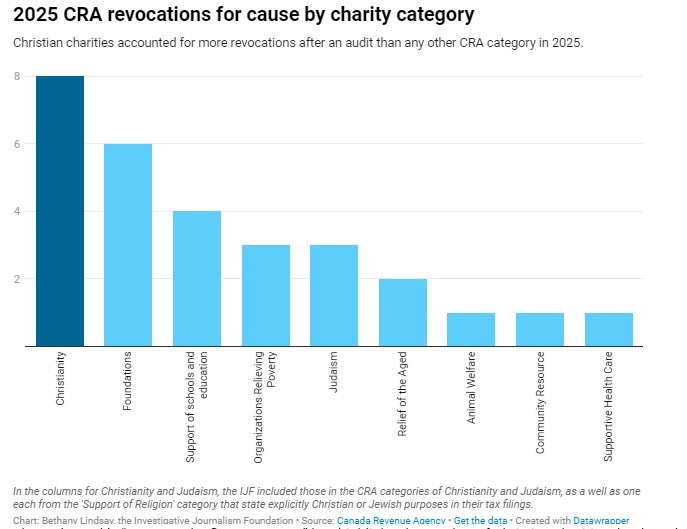
A total of eight out of 29 charities that have lost their registration this year after an audit by the Canada Revenue Agency (CRA) were formed to advance Christianity, up from just 10 per cent in 2024. In comparison, three Jewish charities have lost their charitable status this year following audits, along with four charities supporting education and three charities formed to relieve poverty.
“The numbers are high,” long-time charity researcher Don McRae said in an interview with the IJF. “You don't expect churches to be doing things that are off, that are not following the rules.”
The most common reasons for these revocations included not keeping adequate records, failing to devote resources to charitable purposes and problems with filing information returns.
 |
Click on image to enlarge. |
Despite the recent increase, experts in the sector point out that the number of Christian charity revocations for serious breaches of tax law is proportional to their share of the overall Canadian charity sector.
If anything, they’ve been underrepresented in previous years’ revocations. A quick search of the CRA database confirms Christian organizations comprise nearly a third of the more than 85,000 charities registered in Canada.
“They're within the realm of where they should be in terms of if all things were equal … even though they're religious charities and should be nicer than that,” McRae said.
Rev. John Pellowe, CEO of the Canadian Centre for Christian Charities, agreed and said he has no issue with any of the CRA’s revocations this year.
“Sometimes people think their sector is being persecuted or highlighted, and that's not really the case,” he said.
The CRA, in his experience, is “focused on driving out the bad actors who are harming the reputation of all charities, and we support that because we feel that way ourselves. It only takes a few bad apples to ruin the reputation of either all charities or a significant subsector of charities.”
 |
Click on image to enlarge. |
The IJF’s weekly “Power and Influence Report” has highlighted a number of Christian charities that have lost their status in 2025 following audits.
That includes the case of a southern Ontario pastor who has been connected to three revoked churches and has been accused of using charitable funds to pay for family vacations and motorcycle expenses.
There are also examples including a revocation where auditors raised questions about money an Ontario group was sending to the Democratic Republic of Congo, allegations of submitting falsified records and examples of poor record-keeping on spending on missionary efforts in India.
When McRae scrolls through the list of Christian churches that have been revoked for cause in any year, one thing stands out to him: It’s rare to see an obvious connection to a major denomination.
“What it usually means is there's only one of them, or there's a couple of them, but they don't have the administration or infrastructure that the Presbyterians or Anglicans have,” he explained.
Indeed, despite leading an organization that represents 3,200 Christian charities, Pellowe said he didn’t recognize any of the eight revoked Christian charities in the IJF’s tally for this year.
But he believes it makes sense for Christian organizations to invite the scrutiny of CRA auditors.
“Most of them will have international components to the work that they do, because it's overseas relief and development work,” Pellowe said. “Just by the nature of what our sector does, it will attract attention.… You're doing something that is considered a higher risk level.”
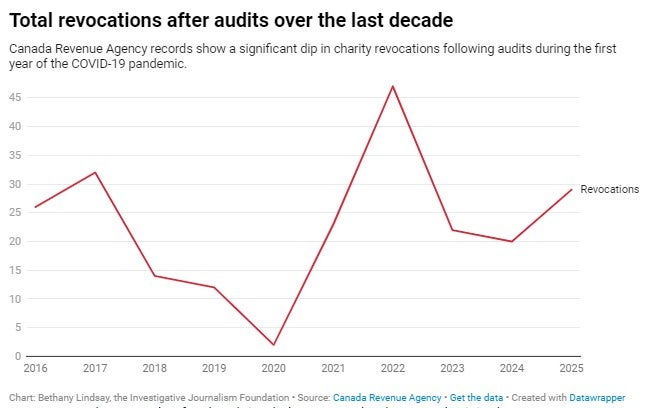
Overall, the 29 charities revoked for serious breaches in 2025 make up just a tiny fraction of the more than 1,900 organizations that ceased being charities this year. The vast majority were either voluntarily revoked or revoked for failure to file tax returns.
The revocations this year follow a steady decline in the overall number of Christian charities registered in Canada, something that McRae has been following. His research identified a net loss of 295 Christian charities in 2023, a trend he says appears to be continuing.
He connects the suspension of in-person services during the pandemic to a loss of revenue that has forced some churches to close their doors. Though McRae describes himself as an agnostic, he worries about the consequences of this decline.
“You're losing part of the community glue,” he said.
 |
Click on image to enlarge. |
McRae gave the example of a church in Chelsea, Que., that he recently visited.
“The church was a meeting place — so, they held concerts and that type of thing. They held Alcoholics Anonymous meetings there. They held a youth support group. They had a thrift shop operating out of their basement,” he said.
“It's a small church, probably it'd be hard pressed to have 100 people in it, but there were probably 12 different things they did in the community.”
Pellowe is a lot more optimistic about the future. He acknowledged that the number of churches in Canada has declined in the last few years, particularly in rural areas where congregations in neighbouring towns have had to merge.
“The pandemic was a terrible thing — I have to say that right at the start. There was a lot of pain and suffering. However, there was a positive redemption of it in that many Christian charities came out better off than they were going in,” he said.
He explained that there were some temporary savings in operating costs while churches were closed, which helped them plan for the future. Meanwhile, the switch to online sermons helped attract new congregants — something Pellowe has experienced at his own church.
“We had about 750 people on a Sunday before the pandemic. Today, we're at 1,500,” he said.
Methodology note
The 2025 revocations included in this analysis were recorded between Jan. 1 and Dec. 24. To calculate the number of Christian charities that had their status revoked after an audit in a given year, the IJF included all the organizations listed in CRA filings under the charity type “Advancement of Religion” and the category “Christianity.” We also included groups of the same charity type in the “Support of Religion” category if their stated purpose in CRA filings was explicitly Christian. For example, Evangelical World Outreach of Canada’s stated purposes include “to proclaim the gospel of Jesus Christ in Canada and abroad, and to train and prepare workers for Christian service.”
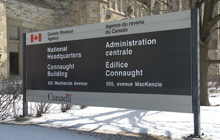
Bethany Lindsay is a Local Journalism Initiative Reporter with the Investigative Journalism Foundation in Vancouver, BC. Title image: Graham Hughes/The Canadian Press.






(0) Comments