

BC towns fight pipeline tax break that would gut municipal budgets
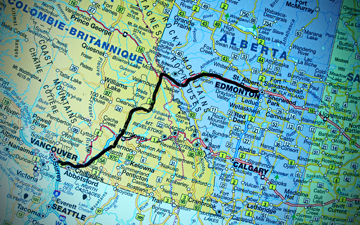
Proposed changes to taxes paid by oil companies would mean $100 more in property tax for every man, woman and child in towns along BC pipeline routes
VANCOUVER, Nov. 27, 2025 – Communities in BC are waiting to see if the province will make taxation changes that allow pipeline companies to pay fewer property taxes to already thin municipal tax bases.
After years of lobbying the provincial government, major pipeline companies, including Enbridge, Trans Mountain and FortisBC convinced BC Assessment to change how it determines the value of pipelines, lessening the property taxes companies owe. But many communities are pushing back and petitioning BC Finance Minister Brenda Bailey to reject the proposed changes, as first reported by The Tyee.
Based on conversations with Bailey’s staff, District of Clearwater Mayor Merlin Blackwell expects the minister to make a decision no later than the year’s end.
Clearwater and other districts and towns have been petitioning BC Assessment and the BC finance ministry to reject the proposed changes since October. On Nov. 20, Blackwell and Clearwater staff had a meeting with Douglas Scott, BC’s deputy minister of finance, to air his concerns about the tax changes.
“They wanted to know how this was affecting us. They wanted an understanding of how BC Assessment had communicated with us. They wanted to know the dollars, the pain, what kind of things we would feel as far as impact if this was to go ahead,” Blackwell said in a phone interview with Canada’s National Observer.
To him, it felt like a way to “find a way to hold off this decision or temper it in some way,” Blackwell mused.
“They were looking for that information to help give the finance minister a way of saying, ‘Hold on, we need to either dig into this more and phase it in,’ or something along those lines.”
Blackwell said staff at the Thompson-Nicola Regional District have a similar meeting on the books with Premier David Eby Wednesday — replacing a previously scheduled meeting with lower level government officials — which says the province is “probably working very hard to come up with a decision on this.”
The pain will be felt in places pipelines run through, such as the Districts of Clearwater, Hope, Kent, Houston and Chetwynd; the Cities of Kamloops and Rossland and the Regional Districts of Thompson-Nicola and Fraser-Fort George, according to a District of Hope report from October.
“We are taking basically an eight per cent tax hit here, which the equivalent dollars is $250,000 a year, is what we're looking at, which equals $100 per man, woman, child,” said Blackwell. This varies for each town and district along the Trans Mountain pipeline and gas pipelines in BC, he said, noting that the City of Hope could lose $640,000 annually in property tax revenue. According to a report from the District of Hope, this would require a nearly six per cent property tax increase for residents and businesses to offset the losses.
The $100 per person calculation for Clearwater does not include other impacts, Blackwell said.
“Businesses get taxed at a higher rate, so theoretically, small businesses and everybody else will, if this cut comes through, they'll be asked to shoulder more of a burden percentage wise than just the average taxpayer,” he said.
Blackwell sees this proposed valuation change as part of a pattern of the public being asked to foot the bill for fossil fuel infrastructure. The federal government put up billions in direct funding and taxpayer-backed loans to get the over-budget TMX project over the finish line, and now taxpayers could be on the hook again because pipeline companies want to pay fewer taxes, Blackwell said.
“We already paid. We've paid at so many levels on Trans Mountain,” he said, referencing not just public subsidies but also the toll it took on the region. “It literally dug a trench and tunnelled through our community.”
‘I have no problem telling a prime minister where he can go’
At the same time as communities are fighting to keep their tax base intact with existing pipelines, Prime Minister Mark Carney and Alberta Premier Danielle Smith are set to announce a memorandum of understanding involving an oil pipeline to BC and various trade-offs on environmental policies.
In Blackwell’s telling, it looks like Carney is trying to “out-conservative” Smith and federal Conservative Leader Pierre Poilievre.
“If this is how Carney is going to deal with Alberta and the federal Conservatives, taxpayers and communities will be the victims of an attempt to outlast Smith and Poilievre through to the next provincial and federal elections,” he said.
“Here we go with Danielle Smith, who can keep her bloody oil in Alberta,” Blackwell said. “Maybe send it east for a change, and run the bloody pipeline through the middle of Toronto and see how well that goes over.”
“And Carney, you know, championing this thing without consultation with the BC government, let alone people that have been affected by the last process, like, Mark Carney can call my office … I have no problem telling a prime minister where he can go with this pipeline.”
Municipalities within the region who would be affected by pipeline valuation changes are coordinating and contacting the Ministry of Finance, the District of Hope’s director of finance Mike Olson wrote in a report to Council on Oct. 22. He noted that the District of Kent and Hope also raised these issues with local BC Conservative MLA Tony Luck. Harrison Hot Springs council also sent a letter of support to align with Fraser Valley Regional District's letter raising concerns about the pipeline reassessment, according to meeting transcripts identified by Canada’s National Observer’s Civic Searchlight tool.
Another looming concern on Blackwell’s radar is the possibility of the federal government pursuing capacity additions to TMX when his region just escaped the tumultuous TMX years.
“Trans Mountain came through here and disrupted this town in so many ways — socially, economically — and affected our ability to continue with the tourism sector, ran roughshod over our roads for years, left behind a scar across town that is now covered in invasive weeds and all sorts of problems.”
Blackwell said he made this clear during a conversation with an unnamed BC government official on Tuesday.
However, to counter Alberta’s relentless pursuit of a new pipeline to BC’s northwest coast, BC Energy Minister Adrian Dix recently backed a roughly $3-billion plan to “optimize” Trans Mountain that includes increasing the system’s capacity by adding 30 kilometres of new pipe alongside the existing line, new pump stations and other infrastructure improvements.
This is even more concerning than talk of an entirely new pipeline to the province’s northwest coast because Trans Mountain already exists and has done a lot of its “homework,” Blackwell said.
“They already have plans, it's already there, and it's recent enough that, according to somebody I spoke with in the BC government, all it would take would be essentially an amendment to the current set of plans and permits to move forward. They would not have to begin the whole process from scratch again,” Blackwell said.
Natasha Bulowski is a Local Journalism Initiative reporter in Vancouver, BC with Canada's National Observer.







(0) Comments