

In Vancouver, a billionaire developer catches a garden tax break
Taxpayers on hook for million dollars due to tax avoidance scheme of reclassifying future development properties as gardens, parks while awaiting market uptick
VANCOUVER, BC, June 12, 2026 – A patch of long-delayed development land in Vancouver has been temporarily turned into dog parks and a community garden. To some neighbours and critics, it looks less like a public amenity than a way to lower the tax bill on land that has sat unfinished for years.
The land is part of the Little Mountain redevelopment, a 15-acre site near Queen Elizabeth Park bought from the province by Holborn Group, a company owned by a Malaysian billionaire family.
The approved project will eventually include about 1,400 market homes, 234 replacement social-housing units, 48 additional affordable rental homes, childcare, a neighbourhood house, a public park and a community plaza.
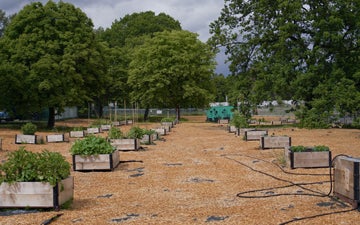
The land was being taxed at a business rate. But in the fall of 2025, Holborn converted two portions of it to community gardens and dog parks, which are taxed at a lower rate. And Holborn isn’t the only developer getting a tax break by shifting how the land is used. A recent City of Vancouver report says this year 10 properties were reclassified, a decision that will force other taxpayers to make up a tax shortfall of $913,300. Two Holborn properties accounted for roughly $315,000 of that total.
“The fact that this property is getting such a considerable tax break — people are going to be outraged,” said Michael Geller, an architect, planner, real estate consultant and adjunct professor at Simon Fraser University. “This is legal what they’re doing. The question is, why are they being allowed to do it?”
Cities decide whether to allow community gardens or dog parks on development sites, the provincial Ministry of Housing and Municipal Affairs said in an email response to Canada’s National Observer. If city rules allow a public community garden and the owner properly creates one, BC Assessment must assign the property the lower parks-and-gardens tax category. The land is still valued as redevelopment property, even when its tax category changes.
The City said it does not control property classifications and “does not approve or support the temporary conversion of vacant sites to recreation as a tax avoidance strategy.” BC Assessment classifies properties based on how they are actually used at the end of October every year. Private dog parks on vacant land need a time-limited development permit, while community gardens usually do not.
For neighbours, the tax numbers add to frustration with a site where the developer made big housing promises that have remained unfulfilled for years.
Aaron Williamson, who lives beside the construction site and serves on his building’s strata council, said residents were initially glad to see fenced-off land opened for public use. “We were very excited about it,” Williamson said. “We would have to use dog parks that were farther away and sometimes drive over to these other sites.”
But that excitement faded as the space felt lightly built and poorly maintained, with wood chips spread over a large area and parts of the site worn down by regular use. The site now includes two dog parks and one community garden and residents were recently told another section may become a third dog park. “One would be sufficient,” he said.
Little Mountain has been a lightning rod for controversy for nearly two decades. The former public housing site was transferred from the federal government to the province in 2007 and BC Housing chose Holborn to redevelop it a year later. Most residents were moved out and nearly all the homes were demolished by 2009. But the redevelopment has moved at a glacial speed. Holborn had paid only $35 million of the $334-million purchase price by 2021 and received an interest-free payment extension to 2026 as well as an $88-million low-interest loan to complete the social housing.
The temporary garden has raised questions about what counts as a community garden. Community Garden Builders, which manages the site, describes the Little Mountain garden as “a growing space for community, connection and collaboration,” with 100 raised beds that rent for $20 a year each.
However, residents say the beds are spread across the property, roughly six or seven metres apart, rather than clustered like a typical community garden where neighbours might work side by side, trade advice or build community.
Emails reviewed by Canada’s National Observer show nearby residents have raised concerns for months about dust, construction traffic, laneway access and upkeep of the temporary spaces, including a resident flagging standing water, exposed tarps and grass growing through ground cover at two dog areas in June.
Tax break for waiting
The tax reclassifications come as Metro Vancouver’s housing market has cooled. In May, home sales were well below the 10-year average, while listings were much higher than usual. Apartment sales and prices were also down from last year.
Holborn’s two listed Little Mountain properties were assessed at a combined $61.6 million for 2026, down 58 per cent from 2022, according to BC Assessment.
It is unclear how long the downturn will last, especially given economic volatility from the US, said Brent Toderian, an urbanist and Vancouver’s former chief planner. Earlier in his planning career, cities often pushed developers to use empty lots for something useful instead of leaving them fenced off for years or turning them into surface parking.
However, concerns arise if a tax system gives developers a financial incentive to keep valuable land undeveloped until market conditions improve, said Patrick Condon, UBC professor emeritus and author of Broken City.
“There are six-figure tax breaks for a lot of places like it throughout the city,” Condon said.
Similar gardens near his home around Alma and West Broadway appear rarely used, he said.
Last year, 24 Vancouver development sites were classified as parks and gardens on the 2025 assessment roll, amounting to about $1.1 million in forgone municipal tax revenue. “It’s almost like a scam,” Geller told Canada’s National Observer.
The lower tax category can be defended as a way to reduce risk for developers in a weak market, said Thomas Davidoff, a real estate economist and associate professor at UBC’s Sauder School of Business. If a company buys land and the market turns, lower taxes can soften the cost of waiting instead of forcing a project ahead at a loss.
But the same policy can backfire. “If it’s cheaper to sit on land with a policy like this, then people will sit on land longer,” Davidoff said.
The problem arises when cities “open the floodgates” without clear standards, Toderian said.
“You can, quite frankly, end up with more dog parks or community gardens than you need, and pretty bad examples of each,” he said.
The city should ask whether each proposal is well-designed, well-located and actually valuable to the community, Toderian said. “Is this a loophole that needs to be closed? Not necessarily,” he said. “But it may be a practice that needs to be shaped in the public interest.”
Geller said the Little Mountain tax break should be viewed alongside Holborn’s broader record in Vancouver, including its handling of a downtown heritage building the city ordered demolished after it was neglected and finally declared dangerous. The company is behind a proposal for the former Bay parkade site that would exceed current height limits and helped trigger Vancouver’s tall buildings review.
Holborn told Canada’s National Observer Little Mountain is an active construction site being transformed into “a complete mixed-use community.” The company said unused parts of the site were always intended for temporary community use, including a garden and dog park.
The dog park and gardens opened in fall 2025 and are in their first spring-summer season, Holborn said. A third-party operator maintains them, weeding and wood-chip replenishment are underway, all roughly 100 garden beds are in use and users have given positive feedback, including from residents in other neighbourhoods interested in similar spaces.
Holborn said all five non-market buildings, totalling 282 homes, are complete or under final construction and will be finished this year, ahead of any market housing.
Sonal Gupta is a Local Journalism Initiative reporter with Canada's National Observer in Ottawa. Title image: Two Holborn sites are among the 10 properties listed in the City of Vancouver report as newly moved into the lower parks-and-gardens tax category this year.








(0) Comments