

B.C. budget tax measures lay burden of austerity on the poorest in province
British Columbia's Finance Minister says "this is not an austerity budget." Let's look at the numbers and see for ourselves, say Marc Lee and Andrew Longhurst
BUDGETS are about the choices we make as a society. Politicians often make bold claims but what really shows commitment is money. There are many priorities for this year’s B.C. budget: maintaining public services, investing in people and infrastructure for the future, softening the current economic downturn, reducing inequality, fighting the key issues of the day, and improving sustainability. The budget is also about how we pay and who pays.
Altogether, the central challenge for the budget is to translate the immense wealth of the province into collective well-being. Heading into B.C.’s 2026 budget, austerity measures were top of the agenda due to policymakers’ perceptions that B.C. has a “structural deficit” rather than a balanced position over the course of the business cycle. An austerity mindset is bad news: it means the loss of public service talent, deteriorating public services and reduced ambition to meet the challenges of our times.
On the surface, the budget appears to have dodged austerity, with the Minister of Finance boldly declaring that “this is not an austerity budget”. However, key spending areas have been given very small budget increases, spread over the three-year fiscal plan, which mean real cuts to services. In addition, the B.C. government’s tax increases will hit low- to moderate income households. Put together, the budget lays the burden of austerity on the poorest in BC.
Key points:
Spending cuts undermine the quantity and quality of public services, and have a disproportionate impact on the lowest-income households. Health care and education spending is already under restraint in the current fiscal year (2025-26) and this pattern continues for the three-year fiscal plan. The budget aims to cut 15,000 public sector jobs by the end of the fiscal plan (2,500 in core services and 12,500 in the broader public sector).
Fears over B.C.’s debt and deficit are overblown. While B.C.’s debt has grown in recent years, the province retains an enviable fiscal position relative to any other province in Canada. BC also has substantial assets, financial and physical, and most of the increase in provincial debt is balanced by creating new provincial assets.
B.C.’s operating deficit is well within historical norms, and debt service costs remain low relative to total expenditures. In light of the multiple hits to the B.C. economy arising from U.S. trade and a housing downturn, it is appropriate for the B.C. government to run deficits at this time.
The budget includes a lot of padding, with $5 billion in contingency reserves included in each of the years of the fiscal plan (and $4 billion in the current fiscal year). At the end of the fiscal year, B.C.’s deficit is highly likely to be much smaller than what’s listed in the budget. However, those contingencies also represent an opportunity to shore up spending areas that have been squeezed.
B.C.’s ending of the consumer carbon tax in April 2025 put a $2.4 billion hole in the B.C. budget. At the same time, B.C. eliminated the $1 billion Climate Action Tax Credit, which was an important income transfer to low- and moderate-income households. This budget now axes a personal income tax cut originally implemented in 2008 along with the carbon tax, and a benefit for Northern households funded out of carbon tax revenues (but delivered through the Home Owner Grant).
Tax increases are also part of the picture. For the wealthiest, only modest increases in the Speculation and Vacancy Tax and property tax brackets for homes assessed at more than $3 million are implemented. These have a relatively small fiscal impact. This budget would have been a good time to end the $1 billion Home Owner Grant, which goes to many affluent homeowners in homes assessed up to $2 million.
Meanwhile, the increase in taxes for the bottom personal income tax bracket and de-indexation of tax brackets (no longer increasing them in line with inflation) starting next year boost tax revenues by $800 million per year and increased sales taxes on professional services another $530 million (when fully phased in). There is a modest increase in tax credits aimed at offsetting some of this increase.
Spending cuts
If we break down provincial spending, 41 per cent of expenditures are for the public health care system, another 21 per cent for education and 11 per cent for social services including social assistance and child welfare. The remainder comprise a broad range of what the provincial government does, everything from transportation and policing to economic development and debt service.
Most of that funding goes to pay wages and salaries for public sector workers. The budget aims for 15,000 FTE job cuts across the broad public sector over the three-year fiscal plan. Provincial spending also includes income transfers to low-income and other marginalized groups. Cuts to the B.C. budget thus directly have an impact on a wide swath of people in B.C. already struggling to get by.
Hospitals and regional health authority services make up about 70 per cent of the health budget, followed by physician services and B.C. Pharmacare. Although the health care budget has received healthy annual increases over the last decade, this budget fails to maintain existing service levels.
Real spending cuts have come to public health care services. Regional services, including hospitals and community services, will only see a teeny 0.7 per cent increase in 2025-26 (the current fiscal year) — far below what is needed to maintain service levels and account for inflation and population growth and ageing.
The budget offers few specific measures to address the many health care challenges, aside from previously committed capital investments in hospitals and health facilities. As a new CCPA analysis shows, fewer British Columbians have access to a family doctor (and very few have access to a primary care team), despite increased spending on doctors. In 2026-27, spending on doctors is projected to increase by 9.3 per cent—the largest increase within the health care budget. Budget 2026 does not provide indication that evidence-based primary care models, like community health centres, will see increased investment.
On seniors’ care, despite the Seniors Advocate finding that B.C. has a shortage of 2,000 long-term care beds today — jumping to 16,000 beds over the next decade — Budget 2026 offers no spending plan to address this growing access crisis.
Instead of fast-tracking new long-term care beds, Budget 2026 puts the brakes on previously planned public long-term care homes. New CCPA analysis finds that increasing private, out-of-pocket spending on seniors’ care is one of the main indicators that the publicly funded system is not meeting the needs of British Columbians. Our analysis found that per capita private long-term care spending increased by 112 per cent while public spending increased by 50 per cent from 2014 to 2023. Private spending comes in the form of out-of-pocket household and private insurance payments.
The budget does strengthen seniors’ long-term care by bringing non-profit and for-profit care providers into the public sector labour relations structure. This will help ensure consistent pay, benefits and working conditions for care workers regardless of whether they work in non-profit, public or for-profit facilities. This transition is expected to cost $185 million over three years. A commitment to begin phasing out for-profit facilities—shown to provide lower staffing levels than non-profit facilities—is absent from the budget.
Previous budgets prioritized mental health and substance use investments — but not in this budget. The B.C. government’s pilot of drug decriminalization ended last month and added restrictions to the safer supply program. Even as toxic drug poisonings continue, the B.C. government has backed away from a harm reduction public health approach in favour of recovery and abstinence models as well as forced treatment beds—approaches that are not evidence-based. The B.C. government puts $131 million over three years into specialized mental health, substance use services and forced treatment beds. The budget remains silent on expansion of mental health services for the broader population, including how it could be better integrated into primary care.
Education will also suffer from real cuts in services. Post-secondary education in B.C. is in the midst of a crisis due to the collapse of international students arising from new federal immigration targets. Many post-secondary institutions grew on the basis of recruiting international students who pay substantially more than domestic students. Ultimately, this model was a reaction to the B.C. government failing to provide sufficient resources into the system. K-12 funding restraint may lead to real reductions in service quality: larger class size; fewer resources to accommodate children with disabilities and special needs.
In child care, B.C. was a leader after introducing a $10-a-day program in 2018 but since then has been a laggard relying only on federal transfers for any expansion. As a result, the system remains challenged with relatively few $10-a-day spaces. A modest increase over the fiscal plan is welcome but barely keeps up, nor does it address the existing backlog. There is no plan to achieve universal child care services.
Housing funding is also being squeezed, even as a housing downturn spreads. In past publications, CCPA has recommended 250,000 non-market units over a decade in order to boost the supply of long-term, affordable housing. The current B.C. government has supported just under 40,000 units since 2018 (some of which are still under construction), although it campaigned on 118,000 new rental units in the 2017 election. Unfortunately, B.C. is pulling back from new capital funding in support of non-market housing development, cancelling a planned funding competition for which non-profits have already paid out time and money.
Overall, taxpayer-supported capital spending is reduced in 2026/26 by $2 billion relative to last year’s budget fiscal plan (from $15.7 billion to $13.7 billion). Again, these investments also create assets so cutting back is not helpful.
Climate action, energy and resources
The biggest revenue story over the past year is the killing of the consumer carbon tax. This has led to a collapse in carbon tax revenues of $2.4 billion leaving only a couple hundred million to be paid under the industrial carbon pricing system. Big polluters are paying next to nothing for their emissions, with about one-quarter of B.C.’s total is from the oil and gas industry.
Alongside this, the B.C. government eliminated a $1 billion income transfer (the climate action tax credit) which went to low- and modest-income households. Given that those low-income households don’t burn as much carbon, the vast majority benefitted from the carbon tax regime. The increase to the personal income tax essentially raises the bottom bracket rate that was part of the carbon tax framework back to what it was before, but the budget does not reverse the tax cut in the second tax bracket from 2008.
For the immense volume of resources companies extract in B.C., provincial finances are getting shortchanged. In the early 2000s, B.C. used to pull $3-4 billion per year from resource royalties—at a time when the economy was one-third the size it is currently ($136 billion in 2000 GDP compared to $463 billion in 2026). While natural gas revenues are forecast to increase somewhat, they are still quite small relative to the size of the economy. B.C.‘s natural resource revenues averaged 2.4 per cent of GDP in the early 2000s, but only 0.7 per cent of GDP in the fiscal plan.
Corporations who profit from extracting and selling public resources need to pay back more of that value to the public purse. In 2024, for example, B.C. exported $35 billion worth of resource products (metals, coal, oil and gas, forestry) but the public sector pulled in a mere $1.7 billion in royalties for those same sectors. Note that royalties are different from taxation; royalties are the return to the public owner of the resource for the private development of that resource.
Some modest improvements in the royalty regime for oil and gas occurred out of a provincial review in 2021-22, and royalties are projected to be modestly higher, but much more could be done. Other areas like mining pay a pittance for the value extracted and need their own review processes to dig into the economic rent associated with projects and ensuring the public and First Nations get adequate compensation.
B.C.’s deficit and debt in context
As for how large B.C.’s debt is, most commentators who say that provincial debt levels are too high are just arguing with large numbers, pointing fingers at how big the debt has become in nominal dollars. But the economy is growing as well, and provincial assets (financial and physical) are increasing, something that fiscal hawks never bring up. B.C.’s economy is twice as large in 2026 as it was in 2013.
Compared to other provinces, B.C. is in excellent shape and has the fiscal capacity to increase its total debt—especially for investments that boost long-term growth. A full apples-to-apples comparison was published by the Financial Accountability Office of the Ontario government in 2024, and found that BC had the lowest net debt of any province in both per capita terms and as a share of GDP (even better than Alberta). While debt has increased the past couple of years, B.C.’s starting point is important context.
For the government what matters is what we spend those dollars on and how much interest we have to pay. For taxpayer-supported debt B.C. will pay about four cents per dollar of revenue over the fiscal plan. Spending that invests in people (child care, education) and that improves our capacity to move people, goods and services, enables future economic growth.
Fiscal hawks also neglect the role of stabilization policy because right now the economy is being undermined in a number of different ways, including housing and trade. The underlying B.C. deficit is about two per cent of GDP, after accounting for large $5 billion per year contingency reserves. This is appropriate given the overall state of the economy. The federal government is also leaning into deficits of the same magnitude relative to GDP in order to support demand at a time when consumers and businesses are retrenching. This is how it should be and it’s a core component of good fiscal policy.
In addition, history tells us that we can get out of a fiscal hole pretty quickly. During strong years of economic growth GDP will rise anywhere from seven to 12 per cent per year (an average over the past quarter century, including recessions, of five per cent per year). Because of the way the budget is constructed, including conservative assumptions about revenues and extra padding, the end of year budget balance is almost always better (bigger surplus or reduced deficit) than what’s tabled at budget time. For example, there remains $4 billion in contingencies booked for 2025-26 and this rises to $5 billion in each year of the fiscal plan.
In addition to the operating balance, the deficit on expenditures relative to revenues, much of the increase in taxpayer-supported debt is due to increased capital expenditures. These include investments in schools, hospitals, freeways and transit, and some housing. The increase in taxpayer-supported debt in recent years is unavoidable, reflected in both operating deficits and other capital spending. Even in GDP terms, taxpayer-supported debt will be 26.1per cent in 2025-26 and is projected to hit 30.6 per cent in 2026-27. Add in higher interest rates relative to the past quarter century and yes, we do need to start paying serious attention.
The key question is what we are spending on. Public services in general are an investment in people and a wealthy society like B.C. needs more of the care economy and less digital baubles. A lot of other infrastructure spending supports households and large and small businesses. In health care, we could definitely spend better, especially in primary care. If anything, we should be investing much more in high quality child care, both for its benefit to kids and beneficial impact of higher female labour force participation.
Leadership needed
B.C. is an exceptionally wealthy part of the world with abundant natural resources, excellent infrastructure and skilled people. That collectively produces our annual income or gross domestic product. Over the past quarter century GDP in B.C. has grown an average of five per cent per year and BC’s 2026 GDP will be double what it was in 2013.
The problem is that we are not adequately sharing the wealth, with too much of the economic gain concentrated at the very top of the income ladder and relatively little making its way down to people at the bottom. In B.C., we are not all in the same economic boat: some are travelling first class, and others are crowded below decks.
The B.C. government has a central role to play in ensuring that the wealth generated in the province benefits everyone—that we build an inclusive society. If we don’t do that, no amount of economic growth will solve this basic problem. This includes “pre-distribution” measures to reduce the inequality of market income through higher unionization rates and increases to minimum wages.
Progressive taxation and spending on public services are also key avenues to reduce inequality, and this is where the budget comes into play. Tax increases on income and sales will hurt low-income households on top of the loss last April of the $1 billion climate action tax credit. In effect, the budget adversely affects areas that help people at the bottom of the ladder and will worsen inequality in the province.
Finally, to the extent that one cares about deficits and debt, cutting spending is not the solution. It’s time to raise taxes on affluent households and increase resource royalties paid by corporations. Now would be a great time to launch a Fair Tax Commission, to engage the public and make recommendations about how to improve the tax system so that it provides the fiscal capacity needed for a vibrant public sector, to invest in the next generation and ensure a good life for all.
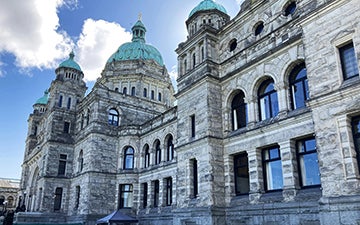
Marc Lee is a senior economist and Andrew Longhurst is a senior researcher and political economist, with a focus on health policy, at the Canadian Centre for Policy Alternatives. This article was originally published by the Canadian Centre for Policy Alternatives and is reprinted under the Creative Commons Attribution-Noncommercial-No Derivative Works 3.0 Unported license. Title image: Legislative Assembly of British Columbia, Belleville Street, Victoria, BC, Canada (Ronin on Unsplash).







(0) Comments