
Alberta: Taxation bump curbs tourism momentum in short-sighted tradeoff, warns industry leader
The province appears to underplay the role a robust tourism economy could play in insulating its accounts from geopolitical vagaries like the price of oil
FORT MACLEOD, AB., April 25, 2026 – New Alberta taxation is chipping away at tomorrow’s visitor economy in the name of addressing today’s budget challenges, an industry leader said Thursday.
Darren Reeder, the CEO and president of the Tourism Industry Association of Alberta, said tax increases in the latest UCP budget are already altering the script on an unfolding success story — the one where the sector is well on its way to hitting a visitor spend of $25 billion a year by 2035.
Other provincial moves have so far helped generate positive industry results, said Reeder, the principal of 2thePOINT Public Relations in Canmore and a former executive director of the Banff & Lake Louise Hospitality Association.
Tourism and Sport Minister Andrew Boitchenko is “not wrong” when he touts wins like how the industry stacks up against the rest of Canada and how coming major sports events will pump big dollars into the economy.
But now is not the time to put spending and investment at risk, said Reeder.
“We’ve planted this orchard. It’s started to give us fruit early and more fruit than other places,” Reeder told The Macleod Gazette. “But we decided to prune it back heavily instead of spending more on fertilizer to grow it to maturity and get the bounty over a longer period of time. That's the essence of what we're saying.”
A Double-Barrelled Increase
At issue are two revenue generators for Alberta government coffers hitting tourists in their pocketbooks. A 50 per cent increase this year boosts the tourism levy to six per cent from four per cent. Kicking in next year is a new vehicle rental tax of six per cent.
The province estimates the two moves will generate $102 million annually in 2027 as Alberta continues to cope with deficit budgets and struggles to match services and infrastructure to a booming population.
Boitchenko told reporters Thursday that money raised by the car rental tax and tourist levy “goes back to general revenue to support Alberta families,” and pointed to $75 million in spending this year to promote tourism.
Visitors place added demands on infrastructure, so “we have to make sure tourists pay their fair share,” the minister said.
Investment Reluctance Tied to Political Uncertainty
On Wednesday, the Tourism Industry Association of Alberta released a report that predicts lost annual visitor spending of $164 million, estimating that private-sector investments worth $271 million are already stalled. It links losses now and down the road to political uncertainty in and beyond Alberta, as well as the tax increases.
The TIAA report comes out of a survey of 157 tourism and hospitality businesses and an economic analysis by the public policy consulting firm Verum.
The association is a not-for-profit that advocates on behalf of all segments of Alberta’s tourism economy for “a competitive and sustainable business environment that generates substantial economic value for the province,” according to the TIAA website.
Last year, visitor spending hit $15.2 billion in Alberta, an increase of more than six per cent and two percentage points higher than the national average of about four per cent.
Reeder said if the province insists on more tourism taxation, the money should be earmarked for sector-supporting projects.
“How are you actually using that money, in an applied manner, to improve the experience of visitors and create a connection opportunity for them to maybe spend more?” he asked.
Now it looks like the money is supporting “a whole bunch of other priorities. We're saying we can do better than that. We have enough of a targeted tourism strategy that we know the types of things we need to invest in.”
The province could match the new dollars, for example, to improving the east-west corridor that joins Red Deer, Rocky Mountain House and Nordegg. “There’s a tremendous amount of tourism potential there, and more investment in infrastructure would help make that dream come true.”
The Campsite Gap
Provincial campgrounds need investment, too, with the total number of sites not having increased much since Alberta was home to two million fewer people.
“That's not really working today. In fact, it's not meeting demand. It's not allowing people a reasonable shot of booking something because there's over-subscription,” Reeder said.
The province hopes to increase the number of provincially managed campsites by about 900 by 2033. Its inventor totals about 14,000 sites now, 9,000 of them reservable.
“They are talking about it. But you know, how do those things get resourced over time?” said Reeder.
Boitchenko, meanwhile, said Alberta “remains the most affordable place to live across Canada.”
The increase of two percentage points to the tourism levy adds just three dollars to a $150 invoice for a night’s accommodation, he noted.
Explore Alberta or Stay Home?
But Reeder said that statement minimizes the reality of what tourism looks like in Alberta. About 75 per cent of so-called visitors are actually people touring their own province.
A few percentage points of taxation may not seem like much, but “there are other factors at play, and ultimately they affect discretionary spending on an item like tourism.”
International travellers are less sensitive to taxes because their trips already represent a big financial commitment.
Their spending — and tourism investments generally — are affected by political uncertainties, whether provincial like the fall referendum planned for Alberta or geopolitical like tariffs and wars.
Tourism is “an instrument of economic diversification that opens doors to other markets,” said Reeder.
“It’s a gateway industry, an introduction to our culture, to our food, to our natural landscapes. People contemplate investments and living here and building businesses here after they become familiar with the area and the market.”
Yet the future is far from dire, Reeder emphasized.
“We'll continue to do fine,” he said. “But I think our point is … we've been doing more than fine. We've been proving that you can actually grow the sector substantively and make it a real instrument for economic development.”
The government appears to underplay the role an even more robust tourism economy could play in insulating its accounts from geopolitical vagaries like the price of oil.
Tourism can help “normalize the economic cycle” in Alberta, Reeder said.
Boitchenko, the member for Drayton Valley-Devon, said he’ll continue talking with industry representatives to address concerns.
“I saw the numbers in the report,” Boitchenko said. “But the fact remains that we are still growing the tourism industry in our province and we’re still strong.”
Reeder doesn’t dismiss the province’s support, now or in the future.
“Our expectations are that we’ll remain committed as private- and public-sector partners” to hitting strategic goals. We wish to continue to collaborate with government.
"Government has really shown an appetite and a commitment to growing tourism, and we believe there's a lot of great work we've done together."
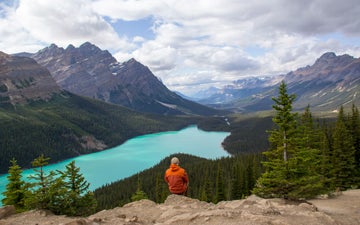
George Lee is a Local Journalism Initiative reporter with the Macleod Gazette in Fort Macleod, Alberta. Title image: Peyto Lake, Banff, Alberta (Jack Deng, Unsplash).




(0) Comments